
Educational Technology in Maine

What is currently happening across the US:
Lower Merion, PA parents ask to opt children out of using devices 24/7
Hundreds of parents in Lower Merion Township, Pennsylvania, are voicing their concerns about the district’s electronic device policy.
During a community meeting held in late March, parents had a chance to speak with school officials about the district’s one-to-one laptop program.
According to the district’s website, the program began at the high school level in 2007 and was expanded to the middle school level after the pandemic.
The district says it “enables students to easily transition projects and research between home and school” by giving students 24/7 access to the educational software and sites on their devices.
Los Angeles becomes the first major school district to require screen time limits
Read story here
The Los Angeles Unified School District’s board voted Tuesday to restrict students’ use of laptops and tablets in class and encourage pen-and-paper assignments instead, making it the first major American school system to do so.
The sweeping resolution, which passed 6-0 with one recusal, requires the district to create a screen time policy for each grade and subject, prohibit students in first grade and younger from using devices, clarify the process for parents to opt their child out of using technology at school, and audit its education technology contracts.
“We have responsibility as one of the largest districts to draw a line in the sand when it comes to this recalibration and start the conversation,” Nick Melvoin, the board member in charge of drafting the resolution, said in an interview ahead of the vote.
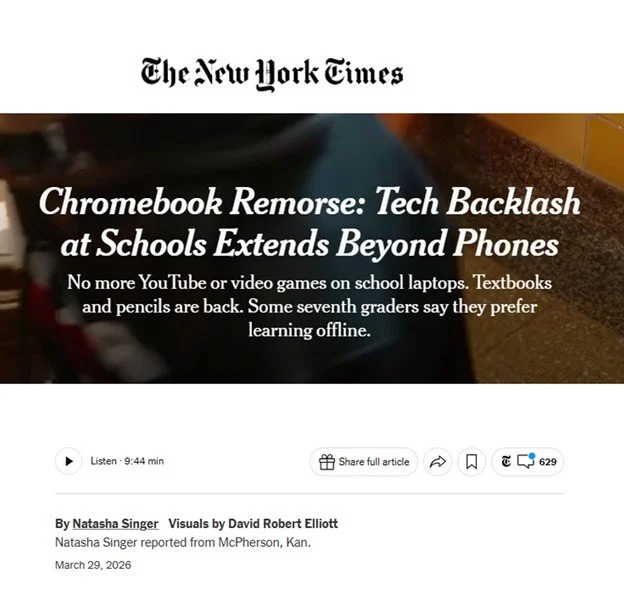
Chromebook Remorse: Tech Backlash at Schools Extends Beyond Phones
No more YouTube or video games on school laptops. Textbooks and pencils are back. Some seventh graders say they prefer learning offline.

Is this topic of interest to you? Would you like to see less screen time/ iPad/ Chromebook use in Maine schools?
If so, the Turn the Tide Coalition has a monthly workgroup to discuss similar efforts in Maine.
What’s happening now?
Maine will Study the Use of Technology in Classrooms and Study Safeguards Related to Its Use
Passed during the Spring 2026 Legislative Session, L.D. 2052 directs the Maine Education Policy Research Institute to conduct a statewide study on how technology is used in classrooms, including how much time students spend on devices, what safety measures and policies are in place (such as restrictions on social media, AI use, and online tools), how well those policies are enforced and compliance with existing Federal laws. The study will also gather expert research on the academic, developmental, and behavioral impacts of digital technology on children. Based on these findings, the institute must submit a report with recommendations for potential policy action at the local level or legislation at the state level to the Legislature by December 1, 2026.
A primer on Educational Technology in Schools
An excellent Summary by Everyschools.org.
Screens & Learning Action Kit - From the Screentime Action Network at Fairplay
Gamification in Education: What Parents Should Know
What is the Maine Learning Technology Initiative (MLTI) and how did we get here?
Why is decreasing technology in schools important (NYT)
How Technology Might be Making Education Worse (Stanford Report)
APA Health Advisory: Artificial Intelligence and Adolescent Well-being (APA)
Maine Education Policy Research Institute (MEPRI) report on Social Media Use by Maine Children and Adolescents
Resisting AI in Education (Emily Cherkin)
YouTube in The Classroom: What Every Parent Should Know (TTC)
Why Maine Schools Must Shun The Screens - Editorial (TTC)
Parents: Resources for Advocating
Sample school board testimony, from Emily Cherkin: Hey, School Leaders: How Many Students Should Be Able to Access Chatbots, Predators, and Porn Before You Will Make a Change?
Essential Reading
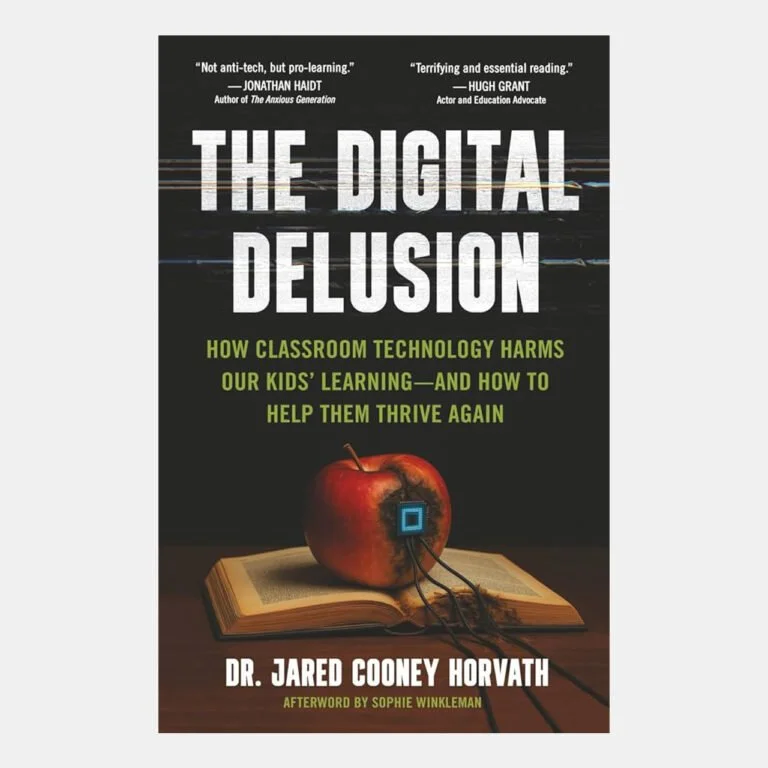
Our children are struggling.
Schools, once alive with deep learning born of human connection, are now dominated by screens. The result is unmistakable: falling performance, fractured attention, and the slow erosion of rigorous thought.
We were told that classroom technology was progress. It wasn’t. In THE DIGITAL DELUSION, neuroscientist and educator Dr. Jared Cooney Horvath reveals why digital tools in school consistently undermine learning – and what parents, teachers, and schools can do to push back with purpose. Drawing on decades of neuroscience and education research, Horvath dismantles the core myths driving the EdTech movement, and offers a practical playbook for putting people – not programs – back at the center of education.
This is not a call to reject technology.
It’s a call to reclaim real learning.
“Terrifying and essential reading.” – Hugh Grant, BAFTA-Winning Actor and Education Advocate
“Not anti-tech, but pro-learning. If you are an educator or a parent, you’ll want to read this book to understand how technology is changing education and changing children.” – Jonathan Haidt, NYU-Stern School of Business, Author of The Anxious Generation.
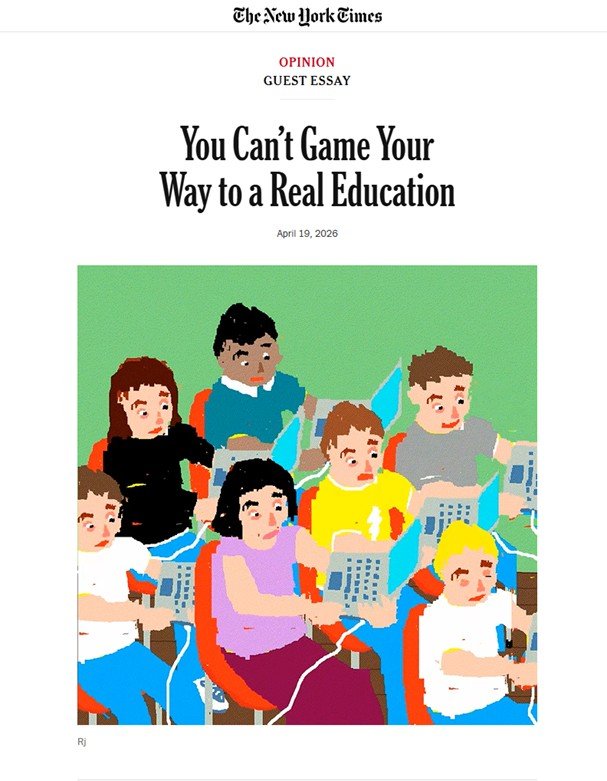
From the NYT : April 18, 2026
….”No technology is philosophically neutral. The apps and games that provide a simulacrum of educational progress also encourage students to absorb a certain worldview, an idea of what they should strive for. They end up with the impression that learning is a matter of box ticking, pattern recognition, completing discrete tasks and “leveling up.”
“When they get to college and face open-ended essay questions and other forms of ambiguity — when they begin thinking about what they should do after graduation and try to figure out the point of it all — they panic. When a professor asks them to read an entire novel, the task feels overwhelming.
“They got into college by mastering a gamified system. But that’s a false picture of the world. Take it from Emerson. He wrote in “Self-Reliance” that real education requires a person to learn that there is no algorithm for fulfillment: “Though the wide universe is full of good, no kernel of nourishing corn can come to him but through his toil.” Serious intellectual work and moral reasoning cannot be gamified.”
